CAYIN Signage Learns to Read the Room
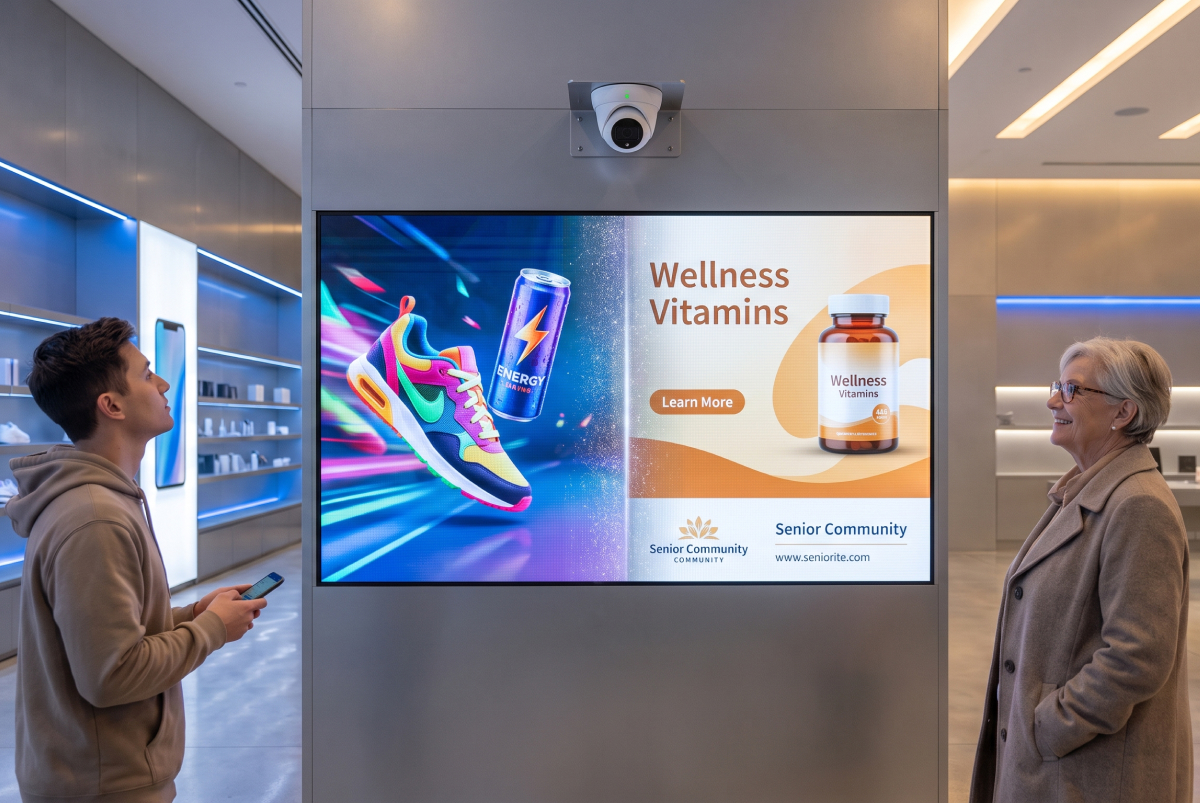
The Screen That Pays Attention
Picture a shopper pausing in front of a storefront screen. In the moment before they even glance at their phone, the display has already responded, switching to a promotion that matches what an external camera has just detected about the audience in front of it. That shift, invisible to the viewer but deliberate on the system side, is what AI AudienceSense is designed to do. The feature works by pairing an external camera directly with each SMP series player, detecting audience attributes in real time and triggering pre configured content to match. No external facial analysis server is required, and supported players can be enabled quickly just by connecting a camera.
From One Camera to a Full Room
For venues that need broader coverage, or need to monitor multiple entry points at once, SMP series players can connect directly to one external camera for facial analysis; to support up to four Face Recognition Sources, pair with QNAP QVR Face Tiger or QVR Face Insight, giving operators a path to scale gradually from a single screen to a multi camera, multi venue deployment without changing platforms.
One Feature for Every Room
This flexibility makes AI AudienceSense suited to a wide range of environments. A retail brand can rotate promotions based on the makeup of shoppers passing a display. A restaurant can adjust menu boards through the day. A healthcare facility can keep waiting area content relevant to who is present, and a bank branch can surface the right service messaging at the right counter. In each case, content becomes something the screen decides in the moment, not something scheduled days in advance and left unchanged.
Available Now
AI AudienceSense reflects a broader shift already underway in digital signage, where the value of a display is measured less by what it can show and more by what it knows about the moment it is showing it in. AI AudienceSense is available now across the SMP-2200, SMP-2400, and SMP-8100 media players. Camera expansion through QNAP QVR Face Tiger and QVR Face Insight is available for deployments requiring wider coverage.
Media Contact
CAYIN Technology Co., Ltd.
Fax: +886-2-2595-1050
Email: press@cayintech.com
Address: 3F., No. 57, Sec. 3, Zhongshan N. Rd., Zhongshan Dist., Taipei City 104, Taiwan
Share


